How to Use This Tool
- Enter the battery capacity in Wh and a starting level from zero to 100%.
- Choose a target above the starting level, no higher than 100%.
- Enter effective average battery charging power in W, including device use, conversion losses and taper in that assumption.
Calculation Method
Model energy Wh = capacity Wh × (target percentage − starting percentage) ÷ 100. Model hours = energy Wh ÷ effective average battery charging power W. The entered power must describe the same charging interval.
Worked Example
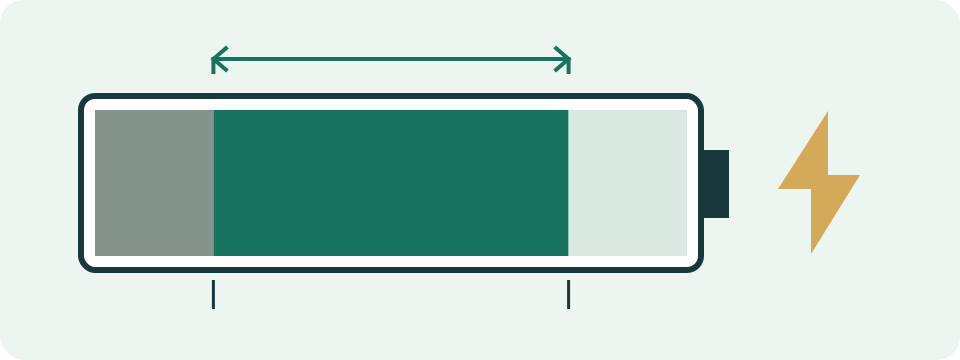
For an illustrative 50 Wh battery going from 20% to 80%, the model energy is 30 Wh. At an effective average 15 W, the model time is 30 ÷ 15 = 2 hours.
Choose the Capacity Basis and the Charging Interval
Use a documented energy capacity in Wh for the battery being modelled. A design rating and a current full-charge estimate can differ. Note which one you entered rather than switching between them while comparing results. A confirmed 60000 mWh equals 60 Wh. A 6000 mAh charge rating is a different quantity and cannot be entered as 6 Wh without a matching voltage and rating basis.
The selected interval is target minus starting percentage. From 30% to 75%, the gap is 45 percentage points, not 75. The form has no voltage converter, battery-type selector or device preset. Its percentage-to-energy step treats that gap as the same fraction of the entered Wh. A device's charge indicator is an estimate, so this proportional energy model is not a precise measurement of stored energy.
What Effective Average Charging Power Means
The W input is the effective average net rate of energy being stored in the battery over the entire selected interval. It is not the adapter's advertised maximum, the USB input peak or the power used by the running device. Even a battery-terminal power reading needs an explanation of how it relates to stored energy before it can serve as this model's average.
A single instantaneous reading cannot establish the whole interval. Record the source, duration, device activity and start and target levels used to choose an average. With no supported average, the form cannot predict a real device's charging time. A clearly labelled hypothetical value can still answer a planning question: how would this assumed energy gap change under a different average?
Check the Energy Result Before the Duration
For a hypothetical 60 Wh battery, a 30% to 75% interval represents 60 × 45 ÷ 100 = 27 Wh. At a separately assumed effective average of 9 W, the duration is 27 ÷ 9 = 3 hours. Holding the energy gap fixed and changing only the average to 6 W gives 4.5 hours. These are independent arithmetic scenarios, not tested charging curves.
The later 75% to 100% interval represents 15 Wh. A separately assumed 3 W gives five hours. That smaller gap takes longer in this example because its chosen average is lower. It does not establish a typical taper rate or a preferred charge target. Keep the W assumption beside each interval instead of treating one average as valid for every endpoint.
| Capacity (Wh) | Start (%) | Target (%) | Average (W) | Energy (Wh) | Time (h) |
|---|---|---|---|---|---|
| 60 | 30 | 75 | 9 | 27 | 3 |
| 60 | 30 | 75 | 6 | 27 | 4.5 |
| 60 | 75 | 100 | 3 | 15 | 5 |
Account for Changing Rates Without Counting Them Twice
Charging can slow, pause or share input power with device activity. Apple describes charging stages for its lithium-ion devices; Texas Instruments documents charging-current reduction and system power allocation. Neither source provides one correction factor for every battery. The calculator contains no hidden taper curve, thermal adjustment or efficiency preset. Its one effective average must already represent the conditions being assumed.
After choosing an average reduced for losses and slower periods, adding another arbitrary loss multiplier counts that reduction twice. A charger rating adjusted by a guessed percentage is still an unsupported estimate. Changing a target, workload or software charging setting can change the appropriate average. Actual charging settings and device messages should be interpreted using that model's manufacturer documentation.
Use an Observed Session Without Overstating What It Proves
Within this model, average net W equals the modelled energy gap divided by elapsed hours. Observing the hypothetical 27 Wh interval over three hours would give 9 W. Re-entering that value reproduces the same session's arithmetic. It does not independently verify the assumed Wh, validate the charge indicator or show that tomorrow's session will take three hours.
Keep comparable observations separate from predictions. Record the device and battery, the report date, the interval, pauses and activity. A device-owned charge-time estimate may use state this webpage never receives. A disagreement is a reason to inspect the input meanings, not proof that the manual calculation is a more accurate reading. There is no battery scan or charging telemetry here.
Resolve Input Errors and Choose the Next Calculation
Capacity and average W must be positive. Start can be zero through 100%; target must be greater than start and no more than 100%. Equal or backwards endpoints, zero power and non-finite results are rejected. Enter 75 for 75%, without a percent sign. A mathematical 0% start is permitted by the form; it is not an instruction to discharge a device.
The result describes added model energy and duration, not operating time or a guaranteed finishing clock time. For time running a workload, use the runtime tool with appropriate energy and average demand. For comparing reported full-charge and design capacities, use the manual ratio tool. Those questions require different inputs even though all three concern the same battery.
What the Result Means
Charging power changes during the interval. Device consumption, conversion losses, taper and software controls affect timing. A charge-percentage indicator is not a perfect energy measurement. This model gives no charging recommendation or guaranteed completion time.
Common Questions
Can I Enter the Wattage Printed on a Charger?
That label does not establish constant battery charging power. Use a supported effective average for the interval; otherwise the result cannot be treated as a device prediction.
Does Choosing a Target Recommend That Charge Level?
No. The target is only a mathematical input. Follow the device manufacturer's instructions for actual charging behaviour.