How to Use This Tool
- Enter a word to include, or leave it blank to use the built-in word bank.
- Choose a style and generate eight ideas. Save names worth discussing with your team.
- Download the shortlist and check the chosen name and tag in your game.
Calculation Method
Local word banks and naming patterns create suggestions. Each batch removes duplicate names. Tags use up to four Latin letters or digits from the name; they are suggestions, not platform-validated identifiers.
Worked Example
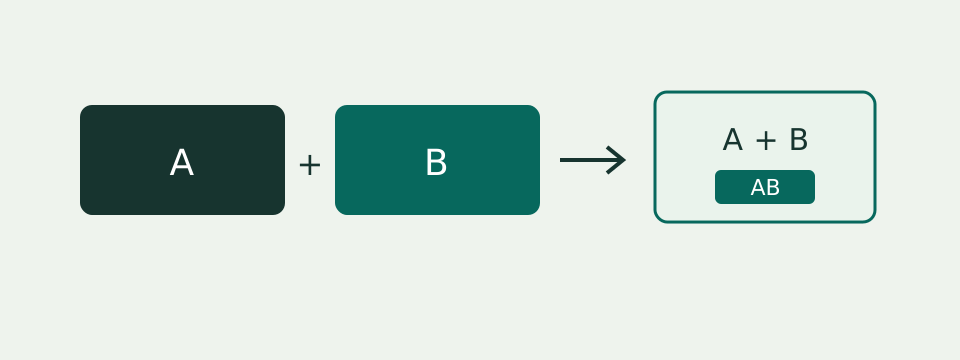
The keyword Orbit can produce Orbit Squad and the suggested tag OS. Your game may require a different tag length.
Choose a Seed and the Team’s Tone
A seed is optional for clan names. Enter a short theme or leave it blank to use the built-in word pool. Choose competitive, fantasy or playful, then generate. The tool combines local words and templates; it does not ask an AI service to interpret a long description, read your gaming account or adapt to a selected game's naming rules. A short seed gives the team something concrete to compare across styles.
Seeds are normalized, trimmed and repeated whitespace is collapsed. Up to 40 Unicode code points are accepted. Start with a letter or digit; letters, digits, spaces, apostrophes and hyphens are supported afterward. Emoji, decorative brackets and other punctuation are rejected. The input box's typing limit is not an additional guarantee of valid seed length. Use the validation message and keep the exact spelling, including accents, when comparing results with the team.
Understand Why Generating Again Can Repeat
Each style contains eight name patterns. With a supplied seed, a batch uses those eight candidates in a shuffled order. Pressing generate again can therefore show the same names in another order. It does not guarantee eight previously unseen suggestions. An empty clan seed uses twelve built-in stems with those patterns, a larger pool of up to 96 candidates before duplicates are removed. Changing seed or style is more useful than expecting endless novelty from one fixed set.
For example, the English competitive pattern can turn the seed Quartz into Quartz Squad. That spelling contains 12 code points including the space; its initial-based tag is QS. This is an illustrative output from the actual pattern, not a recommendation or claim that the name is unused. Other editions use their own templates, so translations need not produce the same character count or abbreviation. Review meaning as well as the displayed length.
Read the Suggested Tag Separately from the Full Name
The tag removes combining accents, keeps ASCII letter-and-digit word groups, takes their initials for multiple words and limits the result to four characters. A single word uses its first four available characters. This is a simple abbreviation rule, not a pronunciation score, platform validator or uniqueness check. Non-Latin text can produce an unexpected abbreviation because the tag rule is narrower than the accepted seed alphabet.
Two different names can share a tag. Review it alongside actual member nicknames and the game’s current field rules. A displayed code-point count is not necessarily the game's byte limit or its count of visible characters. The tool offers no game selector, decorative tag frames or compatibility verdict. Test the proposed full name and tag in the real destination before treating either as accepted. Do not infer acceptance merely from a short result.
Keep a Shortlist Before Changing Pages
Copy sends a selected name to the clipboard; failure is reported. Save adds or removes a name in the current page's shortlist, up to 100. The list exists in page memory, not an account or persistent saved project. Reset restores seed and style but preserves the shortlist; clear saved removes it. Download creates a UTF-8 text file containing saved names one per line. It does not include a complete settings or tag report.
Preserve the downloaded file before reloading or leaving, and record style, seed, tags and review notes separately when useful. Editing seed or style clears the visible generated batch while keeping saved names. The search link opens a quoted Google query only when selected; that action sends the name to Google. Generation itself performs no background search or availability check. A copied or saved name is still only an idea, not a reserved identity.
Check Meaning and Use Before Adoption
Ask teammates to say, spell and recognize the name, then examine unintended meanings in the languages they use. Search for existing teams and check the actual game's rules and field. A search with no obvious match does not establish ownership, clearance or availability everywhere. The name-selection guide supplies a separate review workflow. Create panel artwork only after settling the label, so visual work does not pressure the team into keeping a confusing or already-used candidate.
What the Result Means
Results do not check existing clans, account handles or name permissions. A saved name stays in page memory and disappears on navigation unless downloaded. This tool does not call an AI service.
Common Questions
Are the Names Unique Across Games?
No availability check is performed. Search the specific game and community before choosing.
Can I Keep My Keyword?
Every suggestion includes your entered word. Shorten it to make a more compact name.