How to Use This Tool
- Use documented voltage and Ah for one battery, plus the existing series and parallel counts.
- Enter connected output load in watts and supported capacity and efficiency assumptions.
- Read nominal and delivered energy, then compare the estimate with the exact UPS runtime curve.
Calculation Method
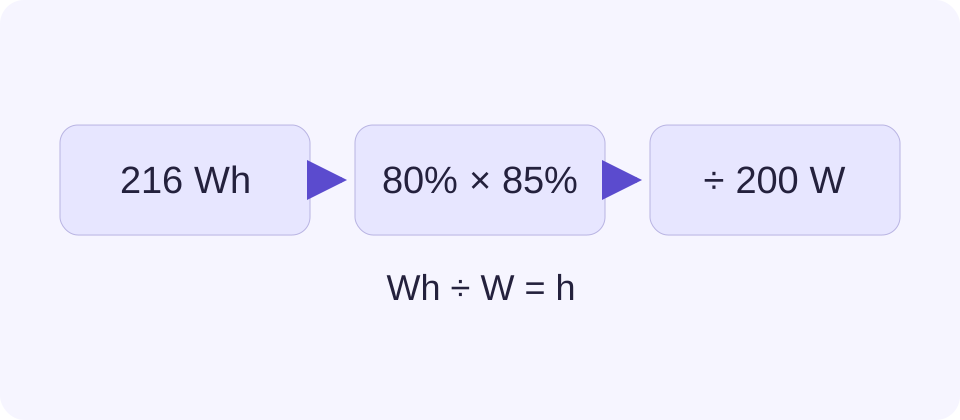
Nominal Wh = battery V × Ah × series count × parallel strings. Delivered Wh = nominal Wh × available capacity fraction × efficiency fraction. Minutes = delivered Wh ÷ load W × 60.
Worked Example
Two 12 V, 9 Ah batteries in series store a nominal 216 Wh. At 80% available capacity and 85% efficiency, 200 W gives a linear estimate of 44.064 minutes.
Start with Battery Energy, Not the UPS Power Rating
A UPS rated in VA or watts states an output capability, not how much energy its battery stores. Two products with the same output rating can have different battery packs and backup times. This calculator needs the nominal voltage and amp-hour capacity of one documented battery, together with the existing battery arrangement.
Read the product documentation or an accessible specification. Do not open a UPS to obtain inputs. Some units provide a total pack voltage and Ah instead of individual battery details. In that case enter the total pack values with one series unit and one parallel string. Counting the batteries again would multiply energy twice.
Keep Series and Parallel Counts Separate
The series count is the number of equal battery units in one string. Series adds their voltages. The parallel count is the number of equal strings; it adds amp-hour capacity. For two 12 V, 9 Ah batteries in series, the bank is 24 V and 9 Ah, giving 216 Wh. It is not 24 V and 18 Ah.
The arrangement controls the arithmetic only. This tool does not establish electrical compatibility, charging support, protection requirements or permission to add external batteries. Use only arrangements supported by the UPS manufacturer. An energy figure alone cannot make an unsupported pack suitable.
Follow the Energy Through a Worked Example
Enter 12 V, 9 Ah, two in series and one parallel string. Nominal energy is 12 × 9 × 2 × 1 = 216 Wh. With an entered 80% available-capacity assumption, 172.8 Wh remains in the model. An entered 85% overall efficiency gives 146.88 Wh delivered to the load.
At a constant 200 W output load, divide 146.88 Wh by 200 W to obtain 0.7344 hours. Multiplying by 60 gives 44.064 minutes. This precision makes the calculation reproducible, but it does not make the real backup time accurate to a fraction of a minute.
| Connected Load | Delivered Energy | Linear Runtime |
|---|---|---|
| 100 W | 146.88 Wh | 88.128 min |
| 200 W | 146.88 Wh | 44.064 min |
| 400 W | 146.88 Wh | 22.032 min |
Choose Load and Loss Assumptions Deliberately
Use measured or documented connected output watts for the equipment that must remain running during an outage. A computer power supply label is a capacity rating, not a measurement of the computer load. Startup peaks and changing activity are separate checks. The UPS must support both the watt and VA demands even when the energy estimate looks sufficient.
Available capacity is the share of nominal battery energy represented in this estimate. Efficiency is the overall fraction of that energy delivered to the connected equipment. Enter evidence-based values where available. Do not automatically subtract the same loss in both fields. Internal UPS power consumption is not a separate input; representing it with one effective efficiency becomes less reliable at very light loads.
Why the Manufacturer Runtime Curve Takes Priority
Real battery output depends on discharge rate, voltage, condition and temperature. A lead-acid battery capacity quoted at a slow discharge cannot simply promise the same energy at a much heavier UPS load. The inverter also stops at its cutoff condition. These effects are not calculated by the linear model, and no hidden correction factor is applied.
The table halves time when load doubles because that is how this equation works. An actual UPS can lose more runtime than that at higher loads. Compare the exact model, installed battery configuration and intended load with the manufacturer curve. Allow shutdown time in the operating plan, and verify automatic shutdown with the supported software rather than relying on a theoretical last minute.
A zero-watt load cannot produce a meaningful finite runtime through this division. Use a positive load and check that it represents the equipment connected at the output. Series and parallel counts describe whole units, not fractions of batteries. A value such as 1.5 does not describe this arrangement. A small valid load can still give an optimistic result because the model has no separate idle-consumption curve.
What the Result Means
This energy model excludes the battery discharge-rate curve, varying voltage, temperature, age, inverter cutoff and separately modelled idle draw. It is not a vendor runtime guarantee or battery-wiring guide.
Common Questions
Can I Use the UPS VA Rating as Battery Capacity?
No. VA describes apparent output power, not stored energy. Runtime requires battery data and connected real load in watts.
Should I Add UPS Idle Power to the Output Load?
The load field represents connected output watts. Use an overall effective efficiency that includes conversion and internal overhead. There is no separate idle-power model; light-load estimates can be optimistic.