How to Use This Tool
- Enter a public IP address, not a URL or subnet.
- Agree to send that IP to the registry through this site’s server and start the lookup.
- Compare the network range and registered holder. Open the source record for details.
Calculation Method
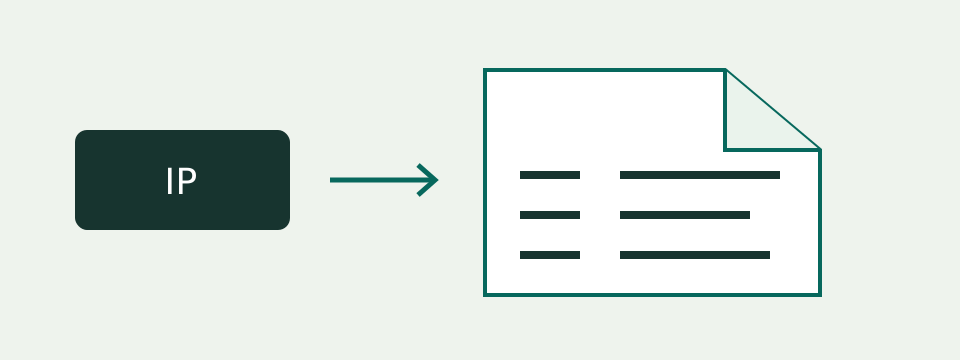
A bundled, dated IANA routing snapshot selects the authoritative regional registry by longest matching prefix. The server requests RDAP over HTTPS from a fixed registry allowlist. It validates that the returned network contains the entered IP, then displays selected registration fields.
Worked Example
The address 8.8.8.8 can be entered to inspect its current registry record. Read the returned range rather than assuming the registered organisation is a household subscriber. This example does not promise a particular current record.
Enter One Public Address, Not a URL
The input accepts one IPv4 or IPv6 address up to 64 characters. Whitespace, brackets, zone identifiers, CIDR suffixes and IPv4-mapped IPv6 forms are rejected. IPv4 is normalised to dotted decimal and IPv6 to a compressed canonical form. Enter the address itself, not a website, hostname, port, subnet or range. Use DNS lookup first when the starting evidence is a domain name, because DNS resolution and registration records answer different questions.
Only public candidates are sent for lookup. Private, loopback, link-local, multicast, documentation, transition and shared-use ranges are rejected conservatively. A private address such as 192.168.1.1 is reused inside many networks and has no subscriber-specific public allocation record. The rejection is not evidence that the address is malicious or malformed for local use. It means this public regional-registry workflow is not the right source for it.
Understand Where the Query Goes
The browser does not contact a regional registry until you tick consent and start. It sends the entered public address to Savvy Toolkit's same-origin IP lookup route. The server selects a registry using the longest matching prefix from a bundled IANA IPv4 or IPv6 bootstrap snapshot. It then asks one allowlisted HTTPS service operated by AFRINIC, APNIC, ARIN, RIPE NCC or LACNIC. The chosen registry therefore receives the address in the RDAP request.
This is server-side because the route can enforce origin, size, endpoint and response rules consistently. The request body is limited to 1 KiB, the browser waits up to 15 seconds and the registry fetch up to 10 seconds. Shared in-process resource controls can return busy. They are not distributed rate limiting across every production replica. Host and provider request logs, retention and outbound restrictions still need owner review before public deployment.
Read the Selected RDAP Fields
The result displays the queried IP and family, network name, registered holder when a registrant entity supplies one, two-letter registration country when present, source registry, handle, start address, end address and UTC check time. It also links to the exact RDAP source URL. Missing fields stay marked missing. The interface does not silently replace absent holder or country with an inference from another commercial database.
Read start and end together: they define the returned registered network that contains the queried address. The server validates address family, parses both boundaries and confirms that the input lies within them. It also requires an RDAP IP-network object. This protects the displayed association from a mismatched response, but it does not prove current BGP routing, service ownership or use by one subscriber. Registration is an administrative record with its own update schedule.
Distinguish Holder, Operator and User
A registered holder may be an RIR member, broadband provider, cloud company, enterprise or holder of a larger allocation. It is not automatically the retail ISP seen by a customer, the organisation announcing every more-specific route or the person using the connection. Reassignment, downstream customers, anycast, hosting and operational changes can add layers not captured by these selected fields. Open the original record and related notices when the distinction matters.
The two-letter country is also administrative. It may describe the allocation record rather than the physical device, network exit or user. This tool performs no IP geolocation, GPS request, reverse DNS, ASN lookup, proxy detection, abuse reputation or VPN judgement. Do not turn the country or holder into a map pin or identity claim. For a public-address observation, use What is my IP first; for hostnames, use DNS lookup separately.
Know the Provider and Safety Boundaries
The server uses a fixed allowlist of five regional RDAP bases and accepts at most two redirects that remain inside that allowlist. It requests JSON, caps the decoded response at 128 KiB and refuses unexpected content or an IP network that does not contain the query. A registry 404 becomes not found, a 429 becomes busy, and other provider or validation problems become unavailable. These outcomes stay distinct from invalid and non-public input.
The bundled IANA routing snapshot is dated project data, not a live bootstrap download on every request. Allocations can change, so the snapshot must be refreshed from the cited IANA IPv4 and IPv6 registries and retested before release and during maintenance. An absent route can reflect stale data rather than absence of registration. The tool does not fall back to arbitrary endpoints, scrape WHOIS text or claim a successful record when the allowlisted RDAP path fails.
Use the Record for a Bounded Task
For network troubleshooting, confirm that the returned range contains the address, note the registry and open the source record. Record the UTC time because registry contents can change. If reporting abuse or an operational problem, follow the current registry record and provider procedure rather than assuming the displayed holder is the correct contact. Savvy Toolkit intentionally omits contact cards and notices from its summary; the original RDAP document can contain additional terms and referral information.
For example, entering 8.8.8.8 asks the current routed registry selected by the bundled snapshot and displays whatever validated record is returned at that time. The example does not promise a holder, country or range. Tests use controlled fixtures instead of claiming a live provider result. Production verification must check outbound HTTPS, registry terms, response variation, rate limits and failure behavior. A successful development build proves code paths, not live provider availability from the eventual host.
Preserve Uncertainty in Attribution
An IP address can be shared by a household, company, carrier gateway, VPN or hosting service, and it can be reassigned. A registration record should not be used alone to accuse, identify or locate a person. Combine lawful, authorised evidence from the relevant service, correct timestamps and appropriate process when attribution matters. This public tool does not access private service logs and cannot establish who performed an action.
Copy copies only the IP, not the complete record. Save the source link, checked time and fields needed for the task without collecting unnecessary personal information. Re-run when a later decision depends on current registration, and label differences instead of overwriting the earlier observation without a date. The related public-IP guide explains private, public and shared addresses. The subnet calculator can model a stated range, but it does not validate the registry's operational routing.
What the Result Means
Registration country is an administrative field, not geolocation. Some records omit country or holder. The registered holder does not identify the current connection user. No device location or VPN verdict is inferred. A registry timeout, missing allocation route or rate limit can prevent a result.
Common Questions
Is the Registered Holder Always My ISP?
No. It can be a network operator or a broader allocation holder. Registry data alone does not establish the subscriber or current routing relationship.
Can I Look Up 192.168.1.1?
Private LAN addresses are reused across networks and have no subscriber-specific public registration. This tool rejects them.