Choose the Question Before Collecting Numbers
How long a device can run, how long a charging interval takes and how a reported capacity compares with its reference are three separate questions. Write the question in one sentence before opening a calculator. A runtime estimate needs available energy and average demand. A charge-duration estimate needs the energy to add and an effective charging average. A capacity ratio needs two comparable reported capacities. One attractive percentage cannot answer all three.
For a planned work session, note the activity and the point at which the device must stop running. For charging, name both endpoints rather than writing only full charge. For a capacity comparison, identify the installed battery and the reference being compared. This small record helps select the right tool and makes a later discrepancy easier to investigate. None of the three manual pages reads battery hardware or automatically supplies the missing measurements.
Keep an Input Record That Preserves the Source
Copy a number with its unit, source, date and exact meaning. Note the device model and battery identity where available. A manufacturer design rating, a current full-charge estimate and a remaining-energy estimate describe different amounts. Opening a report today does not prove that its internal estimate was updated today. Keep the original report or documented reference beside the numbers rather than relying on a percentage copied without context.
The record below is a checklist for your own notes, not a file-upload feature. Some sources do not expose every item. Mark unavailable details as unknown and decide which question can still be answered. A clearly labelled hypothetical value is suitable for exploring arithmetic, but it should not become a claimed reading from the device. Example values in a form are also hypothetical until replaced with appropriate information.
| Record item | What to preserve |
|---|---|
| Capacity | Value, unit, full/design/remaining meaning and battery identity |
| Runtime demand | Average W, workload, observation period and energy basis |
| Charging average | Effective net W, starting/target levels, duration and pauses |
| Comparison | Two comparable capacities, shared unit, source and report date |
Separate Energy, Power and Electric Charge
Wh describes energy; W describes its rate of use or accumulation. Dividing 36 Wh by 6 W gives six hours because the units reduce to hours. NIST lists one Wh as 3600 joules. A confirmed 48000 mWh equals 48 Wh, since 1000 mWh equals one Wh. Read the unit from the documented source instead of guessing it from the size of the number or a familiar-looking field name.
mAh describes electric charge, not the same quantity as Wh. Converting a charge rating to energy needs a relevant voltage and rating basis for that cell or pack. A separate USB-output voltage is not automatically that voltage. The runtime and charging forms accept Wh and have no voltage converter. The capacity-ratio form accepts one shared unit for both values, but selecting a different label does not convert either number.
Keep the Available-Energy Adjustment on One Basis
For runtime, decide what the capacity input counts before choosing a usable fraction. Using a current full-charge estimate and then applying the same capacity reduction again counts it twice. Using energy already reported as available and subtracting the same reserve again has the same problem. Current charge, a chosen stopping reserve and a capacity-retention ratio are distinct facts. The form has one usable percentage, with no automatic combination of those facts.
Consider a hypothetical 48 Wh basis with 75% counted as available: the model contains 36 Wh. At an assumed average demand of 6 W, it gives six hours. Keeping the same energy and changing only the load to 9 W gives four hours. The 75% here is an explicitly chosen energy fraction, not a measured condition score or a recommended reserve. A more realistic input still requires evidence for the chosen energy and workload.
Match Average Power to the Session and the Energy Boundary
Runtime W must represent the average demand compatible with the energy being counted. A short peak, a processor rating and a charger maximum are different facts. Note brightness, applications, peripherals and sleep periods that affect the planned session. An observation under another workload may not represent it. Where periods have different power and duration, total their energy and divide by total time rather than averaging the power numbers without time weights.
Charging W has a different meaning: the effective average net rate of storing energy in the battery over the selected interval. Wall input, a USB-port reading and the device's own consumption are not automatically that rate. Even a battery-terminal reading needs a defined relationship to stored energy. Texas Instruments documents separate system and charging currents. Keep those boundaries explicit, and do not add a second loss factor after the entered average already accounts for that loss.
Calculate the Charging Gap Before Estimating Its Duration
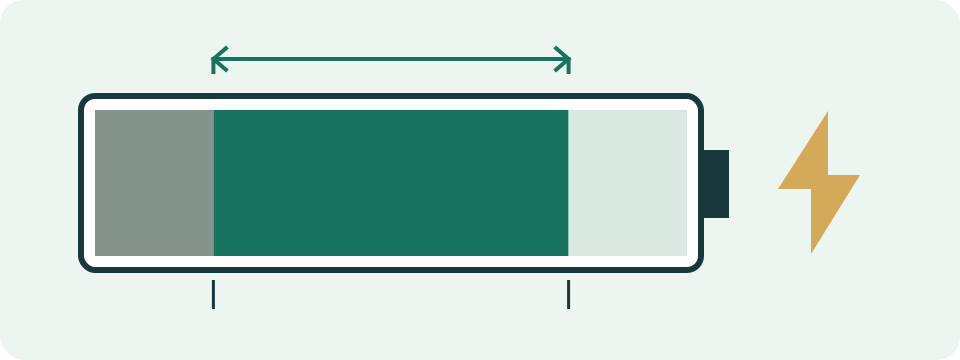
A hypothetical 48 Wh battery going from 20% to 80% has a 60-percentage-point gap. The proportional energy model gives 48 × 60 ÷ 100 = 28.8 Wh. A separately assumed effective average of 12 W gives 2.4 hours, or two hours 24 minutes. The target alone is not the gap, and 100 minus the starting level would describe a different endpoint. Record the two percentages together.
The static interval illustration shows this 20% to 80% division; it does not update with inputs or show a measured charge curve. A charge indicator is a gauge estimate. Treating a percentage gap as the same fraction of Wh is a useful, declared simplification rather than precise energy metering for every battery. The form requires a target above the start, but mathematical acceptance of an endpoint does not recommend that setting for a device.
Use Separate Averages for Different Intervals
A later 80% to 100% interval on the same hypothetical 48 Wh basis contains 9.6 Wh. With a separately assumed 3 W average, that stage takes 3.2 hours, or three hours 12 minutes. These invented stage values teach interval arithmetic; they do not describe a tested device or a universal slowing point. Apple describes charging stages for its devices, while technical charging references describe changing current. Actual timing depends on the particular system and conditions.
Combining these two hypothetical stages gives 38.4 Wh over 5.6 hours. Their combined effective average is 38.4 ÷ 5.6, about 6.857 W. Taking the simple mean of 12 W and 3 W would give 7.5 W and would be wrong because the stages last different amounts of time. Pauses and device activity also belong in a whole-session average. Changing the target can change the average needed, not just the energy gap.
Read a Capacity Ratio Without Confusing It with Charge Level
Reported full-charge and design values of 42000 and 50000 mWh give 84%. Converting both to 42 and 50 Wh gives the same ratio. The calculation compares reported capacities, not the current 84% charge level. It also cannot establish exactly 84% of the original runtime, since workload and other operating conditions remain separate. Save the original capacities and unit with the result so that the comparison can be checked later.
Values of 51 and 50 Wh give 102%, which the calculator preserves. Check the reference, battery identity and reporting definitions before interpreting the excess. A zero supplied numerator gives zero arithmetically, but a missing field or unsupported reading is not a confirmed zero-capacity battery. Apple distinguishes maximum capacity from performance; Google documents model-dependent estimated capacity displays. Neither supports turning this manual ratio into a universal fault, lifespan or replacement verdict.
Compare Observations Without Treating Them as Validation
An observed elapsed duration can help derive a session-specific average under the stated energy model. Dividing the modelled energy by that duration and re-entering the answer reproduces the observation's arithmetic. It does not independently verify the original capacity or percentage-to-energy assumption. Keep measured facts separate from derived quantities, and keep both separate from hypothetical scenarios. That distinction prevents an estimate from gaining false authority through repeated calculations.
For a trend, retain the same battery, compatible reference, source convention and units. Record changes in software, workload and reporting dates. A new percentage may reflect a changed estimate or denominator. It is not by itself evidence of physical improvement. Extra output decimals do not make a source estimate more precise. Compare the manufacturer's own messages and reporting explanation when a manual result disagrees with the device.
Choose the Next Useful Check
A duration question belongs in the runtime tool when suitable Wh and average demand are available. A partial charging question belongs in the charging tool when a defensible interval average is available. A reference comparison belongs in the ratio tool when both capacities exist. When the required evidence is unavailable, keep the device-specific answer unknown. Sensitivity calculations can still show how assumptions affect the model, provided the assumptions remain visible.
For an actual device status or charging message, use documentation for that model and software version. The device may have information these forms cannot receive. This guide does not prescribe charge limits, calibration cycles, repairs or service eligibility. Its purpose is a usable input record and a transparent calculation. Keep that record with the result, so the next change is a reasoned adjustment rather than replacing one unexplained number with another.